
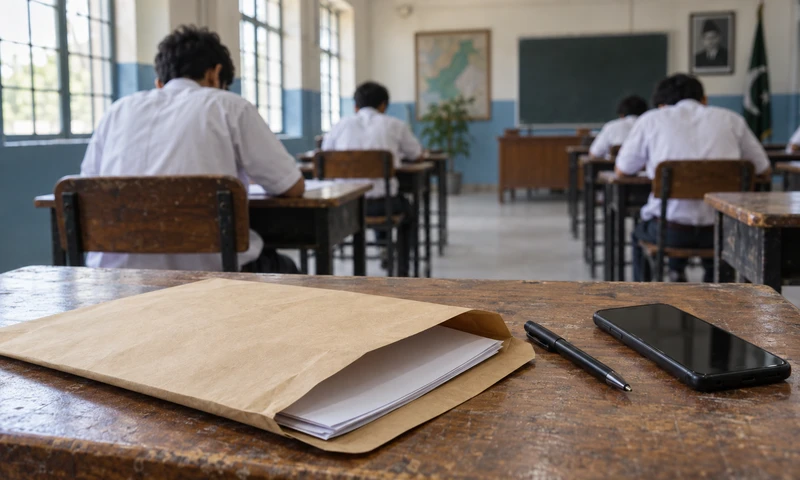
Investigators found no evidence that the O/A Level paper leaks originated in Pakistan, a parliamentary committee heard on Monday. The briefing suggested a possible overseas source, while highlighting limits on tracing foreign servers.
Acting chairman Anjum Aqeel Khan chaired the National Assembly Standing Committee on Federal Education and Professional Training meeting.
Members heard that the National Cyber Crime Investigation Agency (NCCIA) “found no evidence to establish that the leakage had originated from Pakistan.”
However, NCCIA lacks direct access to servers abroad. This restricts its ability to independently trace the source, location and method of alleged leaks through overseas servers.
The finding does not establish which country the leaks came from.
Cambridge exam investigation
The government ordered an inquiry in May following concerns from parents and students about alleged Cambridge examination paper leaks. It directed NCCIA to coordinate with Cambridge Assessment International Education.
Read More: Baitussalam Student Scores a Perfect 200 in Cambridge O Level Mathematics
Separately, Cambridge confirmed that someone had prematurely shared AS Level Mathematics Paper 12 (9709), taken on April 29, 2026. On May 7, it cancelled the affected paper and scheduled a free replacement for June 9.
Cambridge said the incident affected several regions, including Pakistan, and that it was working with law-enforcement authorities.
Lawmakers demand action against campus drugs
The committee also expressed grave concern over reports of drug use and supply in educational institutions. Members demanded immediate, coordinated action to identify suppliers and keep criminal elements away from campuses.
They urged coordination between the Anti-Narcotics Force, police, Higher Education Commission and Federal Directorate of Education.
Read More: Cambridge Announces O Level, IGCSE Results 2026 in Pakistan
Lawmakers sought verified figures showing the number and nature of cases, official action, coordination arrangements, and penalties or punishments imposed.
They stressed that safe, drug-free institutions require clear responsibilities, effective monitoring and strict enforcement. Committees and policies alone would not deliver results without implementation and visible action against suppliers.
Officials said higher education institutions had established Anti-Drug and Tobacco Committees to monitor student drug and tobacco use.
Members called for stronger links with police and regulators to ensure timely reporting, investigation and enforcement.
Skills training and dyslexia support
The committee urged the National Vocational and Technical Training Commission to make its programmes more focused on employment outcomes.
Members highlighted changing international labour demand, particularly in the Middle East. They called for continuous assessments of emerging skills needs and training aligned with overseas employment opportunities.
The Federal Board of Intermediate and Secondary Education reported new examination support for students with dyslexia, following subcommittee recommendations.
These measures include extra time and help reading question papers.
Lawmakers also sought regular psychological support and trained remedial teachers to identify learning difficulties early and assist students in classrooms.
A member highlighted Punjab Assembly legislation on dyslexia and urged a comprehensive, consistent approach.
The Inter Boards Coordination Commission said it would consult all examination boards to promote uniform support measures nationwide.