

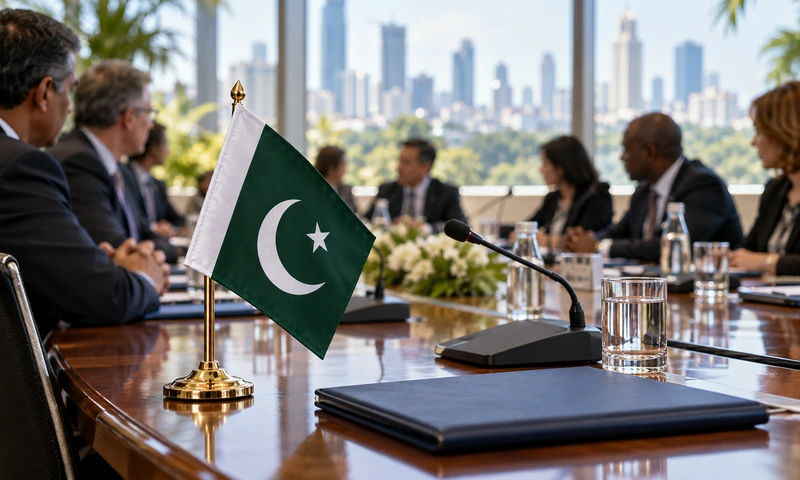
Pakistan secured two institutional leadership roles and explored a potential $1.5 billion financing arrangement at the IMF-World Bank Annual Meetings in Bangkok.
The October 12–18 gathering brought together finance ministers, central bank governors, policymakers, investors and experts. Discussions covered sluggish growth, rising debt, Middle East conflict and artificial intelligence.
Pakistan’s delegation promoted its economic reforms and recent macroeconomic stability while seeking broader financing options.
Economic Affairs Minister Ahad Khan Cheema will chair the IMF and World Bank Group Boards of Governors in 2027. Pakistan last held the chairmanship in 1953.
Read More: Apna Ghar Goes Simpler: How to Apply Online for Housing Finance
The boards represent member countries and serve as the institutions’ highest decision-making bodies, setting their broad direction.
“The forthcoming chairmanship provides Pakistan an important opportunity to contribute to global economic and development deliberations and facilitate constructive dialogue among member countries at a critical juncture for the multilateral system,” Pakistan’s Ministry of Economic Affairs said.
Separately, Finance Minister Muhammad Aurangzeb assumed the chairmanship of the Borrowers’ Platform’s Governing Council on Pakistan’s behalf.
The member state-led initiative helps developing countries exchange knowledge and coordinate on sovereign debt challenges. Pakistan’s priorities include stronger debt management, sharing reform experiences and exploring development-financing instruments.
An official statement clarified that the platform would support technical cooperation and mutual learning, rather than collective bargaining or crisis management.
Financing proposal targets $1.5 billion
Pakistan discussed combining a World Bank policy-based guarantee with Multilateral Investment Guarantee Agency coverage to attract competitively priced financing.
The potential target stands at approximately $1.5 billion. However, the proposal remains subject to the guarantee envelope, transaction structure and further approvals.
Aurangzeb discussed the arrangement with Alvarez & Marsal. He favoured using an existing Development Policy Operation to avoid delays from negotiating a new framework.
The delegation also engaged the IMF, World Bank, AIIB, JPMorgan, Citigroup, Islamic Development Bank, Moody’s and Fitch Ratings.
These discussions focused on reforms, alternative financing and Pakistan’s engagement with international institutions and investors.
War, debt and AI dominate discussions
Globally, participants warned about energy-price shocks, sovereign debt and borrowing costs, particularly amid the US-Iran conflict.
Member countries sought greater support for economies facing short-term financing pressures from war spillovers and expensive energy.
“Escalating conflicts and trade tensions could further disrupt critical trade routes, exacerbate commodity price pressures, including in refined energy products, and worsen energy and food security,” said the statement issued by Saudi Finance Minister Mohammed Al-Jadaan, chair of the International Monetary and Financial Committee.
Read More: Pakistan’s Microfinance Customers Could Soon Get PayPak Credit Cards
IMF Managing Director Kristalina Georgieva highlighted both AI’s promise and wider economic anxieties.
“Optimism from the resilience of the global economy, the promise of AI, the dynamism of Asia. But AI is also recognised to be a source of worry, and so are inflation, high levels of debt, wars, climate risks,” she said.
Anthropic co-founder Jack Clark discussed the scale of possible AI-driven change.
“I know, but it’s implied by the technology continuing to get better. And if GDP were to grow this much, then economic doctrine suggests that new industries and inventions would need to have been created to power such a major economic expansion.”