Pakistan revised FY26 GDP growth to 3.65% from 3.70% on Monday, missing its original 4% target as industry and services weakened.
The National Accounts Committee approved the figures at its 118th meeting at the Pakistan Bureau of Statistics. The government had lowered its growth estimate to 3.70% in May.
Agriculture growth rose to 3.50% from 2.89%. Industry slowed to 3.34% from 3.51%, while services eased to 3.81% from 4.09%.
Fourth-quarter growth slows to 2%
Quarterly growth estimates now stand at 3.89%, 4.31% and 4.42% for July-March, against earlier estimates of 3.92%, 4.05% and 3.99%. Growth then slowed to 2% in the fourth quarter.
The committee cut FY25 growth to 3.11% from 3.18% and incorporated revised import data covering FY21-FY25.
Pakistan’s economy reached $450.4 billion, or Rs126.4 trillion, with services, industry and livestock supporting expansion. Dawn reported FY25 GDP at $410.96 billion; other reports citing the revised accounts put it at $408.7 billion.
Read More: Government Puts Private Sector in Charge of Pakistan’s Economy
Per capita income increased to $1,896 from $1,824, using population projections based on the 2023 census. Earlier readings stood at $1,551 in FY23, $1,766 in FY22 and $1,677 in FY21.
Dawn described the latest income figure as “lowest in region”, highlighting inflation’s pressure on purchasing power, savings and investment.
The revised growth broadly matches lender forecasts: IMF 3.6%, World Bank and Asian Development Bank 3.7%, and SBP close to 3.7%.
Crops improve, manufacturing loses pace
Important crops grew 1.59%, against 0.65% previously, following stronger wheat and maize output. Other crops improved to 4.28% from 2.43%.
Production increased for pulses (6.3%), fruits (1.3%), tomatoes (44%), oilseeds (5.4%) and green fodder (2.4%).
Higher fodder inputs lowered livestock growth to 3.71% from 3.75%. Forestry and fishing grew 10.80% and 1.39%, respectively.
Mining growth improved to 1.52% from 0.38%, supported by gas (2.84%), crude oil (5.12%) and coal (2.73%).
Read More: Pakistan’s Economy Gets Fresh Boost as Exports Rise 13% in July
However, large-scale manufacturing growth, measured through the Quantum Index of Manufacturing, fell to 5.01% from 6.11%.
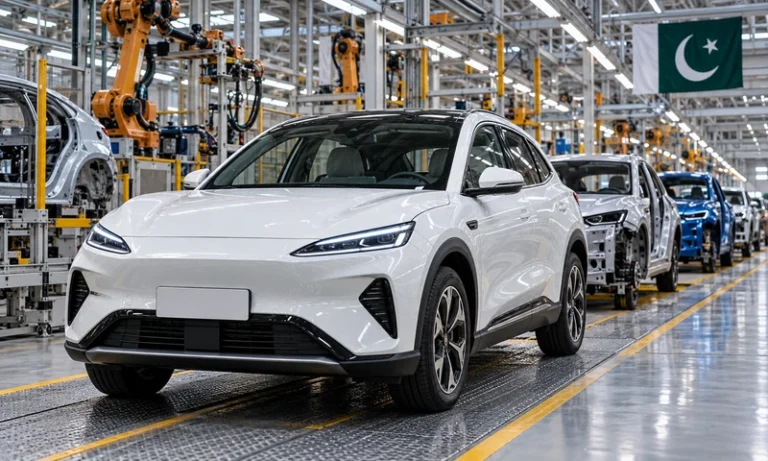
Gainers included automobiles (57.77%), transport equipment (42.36%), furniture (22.69%), football manufacturing (16.62%) and electrical equipment (14.25%). Rubber products grew 14.19%, tobacco 12.61%, petroleum products 9.7% and food 7.03%.
Pharmaceuticals contracted 8.87%, iron and steel 7.84%, chemicals 2.53% and leather products 1.95%. Electricity also contracted 10.24%.
Construction growth strengthened to 6.30% from 5.73%, reflecting higher public-sector construction expenditure.
Services show uneven performance
All services constituents recorded positive growth, although several lost momentum.
Wholesale and retail trade growth dropped to 2.37% from 3.71% as manufacturing and imports weakened.
Transport and storage improved to 3.23% from 2.31%, following upward revisions in railways, water transport and aviation.
Information and communication accelerated to 9.53% from 7.52%. Finance and insurance improved to 4.23% from 0.32%, supported by insurance activity.
Public administration and social security slowed to 5.67% from 8.54%. Education eased to 4.17% from 5.23%, while health and social work slowed to 5.52% from 6.85%.