
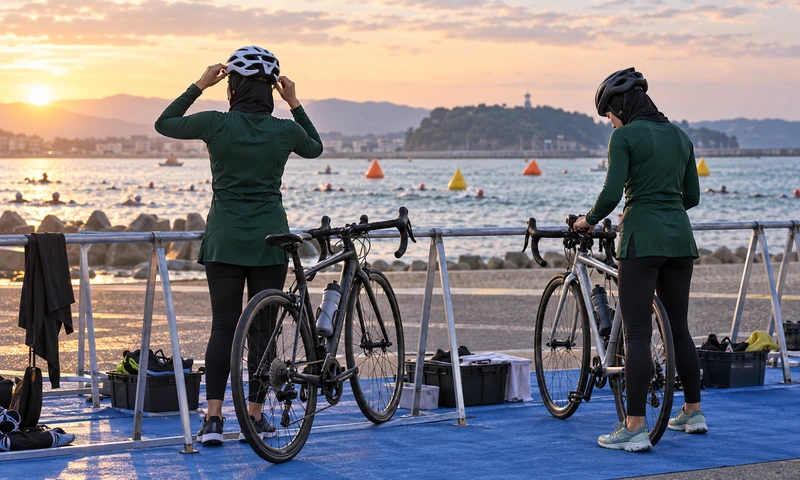
Pakistan’s first women triathletes at the Asian Games have highlighted equipment shortages and inadequate training support after their historic appearance in Japan.
Sana Arif and Anisha Ali represented Pakistan at the 2026 Aichi-Nagoya Games alongside Ali Hassan, Mohid Sadiq Lone and Muhammad Mustaghis Noor. They returned without medals but highlighted the investment needed for future competitiveness.
“If Pakistan wants competitive Asian Games athletes, they shouldn’t start receiving support six months before the event,” Sana told Dawn.
From swimming lessons to the Asian Games
Sana learnt swimming in 2021 before completing three Ironman 70.3 races, combining swimming, cycling and running over approximately 113 kilometres. Born in Kuwait, she grew up in Lahore before returning to Kuwait.
During a Pakistan holiday, a friend alerted her to selection trials. Her swimming ability complemented her cycling and running, helping secure selection. The Pakistan Triathlon Federation called her a week later.
She subsequently trained largely alone. The federation president regularly checked her progress and offered guidance, but no extensive national high-performance programme supported her preparation.
Anisha, 26, comes from Hunza in Gilgit-Baltistan. Her national-level sporting experience includes judo, martial arts, rowing, boating, tug-of-war and fencing. She credited her mountainous upbringing with teaching her to embrace challenges.
The Games’ individual sprint format involved a 750-metre swim, 20-kilometre cycle and five-kilometre run, according to organisers. It differed significantly from Sana’s longer-distance racing experience.
Team support eased competition nerves
The Pakistani athletes developed closer relationships after arriving in Japan.
“We all knew who we were competing against,” Sana said. “Everyone was friendly, shared their experiences and supported wherever it was needed.”
“Though we were the weaker team compared to others, none of us even for a second thought of giving up. We fought till the end.”
Experienced international competitors also reassured her about the unfamiliar format. “They were there to calm me down and tell me that it was all okay,” she said.
Sana described anxiety, stress and excitement surrounding the competition.
She praised arrangements in Gamagori, where accommodation stood near the venue and beach, with island views and a garden running track. Organisers provided a dedicated table for Muslim athletes and vegan options.
“The staff and people were great, and there was a lot of security too,” she said.
Equipment and access remain barriers
Sana said Pakistani competitors used rented bicycles and received unsuitable tri-suits made from inappropriate fabric. She called for proper equipment, funding and structured training.
Anisha said more Pakistani women were entering sports. However, talented girls in remote and mountainous communities still lacked facilities, coaching, financial support and safe spaces. International representation could help them envision sporting careers.
Despite criticism over results, Sana welcomed the encouragement.
“People will always have something to say whether you win or lose,” she said. “No one understands your struggle, and that is okay.”
“The amount of positivity I have received from everywhere is unexplainable.”