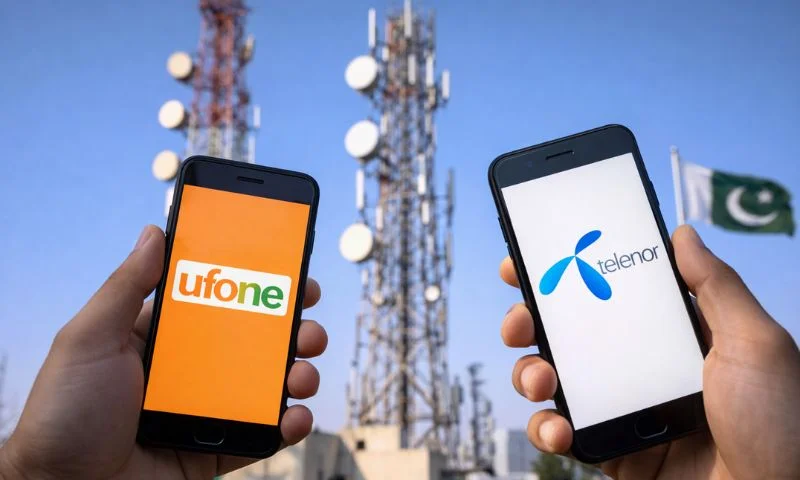
Pakistan’s telecom regulator has approved the long-anticipated merger between Ufone and Telenor Pakistan, but imposed a series of strict conditions aimed at safeguarding competition, consumer interests and market balance.
The decision by the Pakistan Telecommunication Authority marks a major shift in the country’s telecom landscape, reducing the number of major mobile operators from four to three, while placing tight regulatory oversight on the newly combined entity.
PTA imposes strict conditions
According to details, the PTA has allowed the merger to proceed but introduced safeguards to prevent the emergence of a dominant market player. These include restrictions on anti-competitive practices, requirements for operational transparency and conditions to ensure fair access to telecom infrastructure.
Regulators have directed that the merged entity, often referred to as “MergeCo,” must maintain separate accounts and avoid any cross-subsidy between business units, particularly between Pakistan Telecommunication Company Limited and its mobile arm Ufone.
The authority has also barred the company from entering exclusive agreements that could limit competitors’ access to essential services such as bandwidth, a move designed to protect smaller players and maintain a level playing field.
Officials said the conditions are intended to ensure that “the new company could not exploit its dominating position,” reflecting concerns about market concentration following the merger.
Read More: PTA Approves Ufone-Telenor Merger, Reshaping Pakistan’s Telecom Landscape
Major reshaping of telecom sector
The merger follows the acquisition of Telenor Pakistan by PTCL, completed at the end of 2025, and represents one of the largest consolidations in Pakistan’s telecom industry.
With the integration, the combined entity is expected to significantly strengthen its spectrum holdings and network capabilities, potentially improving service quality and expanding coverage.
Industry analysts say the deal could enable greater investment in infrastructure and accelerate the rollout of next-generation services, including 5G, which Pakistan has recently begun introducing in major cities.
However, the reduction in the number of operators has raised concerns among regulators about competition, pricing and consumer choice. The PTA’s conditions are therefore seen as critical in balancing efficiency gains with market fairness.
Read More: PTCL Submits Merger Application to PTA for Telenor Pakistan and Ufone
What it means for consumers
For subscribers, the merger could bring both benefits and risks. On one hand, a larger, better-resourced operator may deliver improved network performance, faster internet speeds and broader service offerings.
On the other hand, fewer competitors in the market could potentially lead to higher tariffs or reduced options if not properly regulated.
Experts say the PTA’s oversight will be key in determining how the merger impacts users in the long term. By enforcing conditions on pricing behavior, service access and financial transparency, the regulator aims to ensure that consumers do not bear the cost of consolidation.
The decision also signals a broader trend toward consolidation in global telecom markets, where operators are merging to cope with rising infrastructure costs and increasing demand for data services.
As Pakistan’s digital economy continues to expand, the Ufone-Telenor merger represents both an opportunity and a test case. The success of the deal will depend not just on operational integration, but on how effectively regulators enforce the conditions designed to protect competition and consumers.