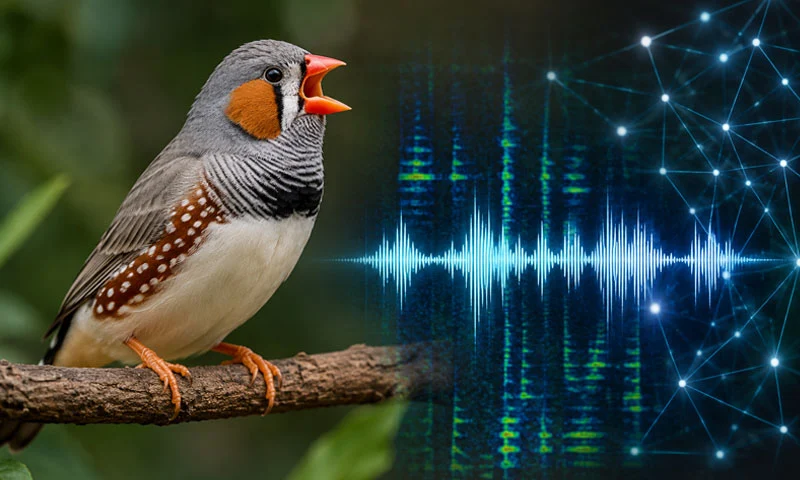
Artificial intelligence is opening new possibilities in one of biology’s oldest mysteries: understanding how animals communicate. A new breakthrough involving zebra finches has strengthened hopes that researchers may one day decode the meaning behind animal vocalisations.
Dr. Julie Elie of the University of California, Berkeley, has received the 2026 Coller-Dolittle Prize for Two-Way Interspecies Communication after her team identified a shared communication system among zebra finches. The recognition highlights years of research that combined traditional fieldwork with modern machine learning.
The scientists found that zebra finches use 11 distinct call types associated with specific situations. Their findings suggest the birds respond not only to the sounds they hear but also to the information those calls carry.
Fifteen Years of Research Meet Artificial Intelligence
The project took more than 15 years to complete. Researchers first spent years recording thousands of bird calls and carefully documenting the context in which each sound occurred.
Only after building that extensive database did the team apply machine learning tools to organise and analyse the recordings. Artificial intelligence helped identify recurring patterns that would have been extremely difficult to detect through manual analysis alone.
Behavioural experiments provided further evidence. When researchers played recorded calls to zebra finches, the birds often confused calls that carried similar meanings rather than calls that simply sounded alike. The results suggest the birds recognise both the identity of the caller and the message being communicated.
The discovery points to a more structured communication system than scientists previously understood.
The Coller-Dolittle Prize awards $100,000 each year for major advances in animal communication research. Organisers have also announced a separate $10 million prize for the first verified demonstration of meaningful two-way communication between humans and another species.
AI Expands the Search for Animal Language
Artificial intelligence is becoming an increasingly important tool in animal behaviour research.
Projects such as the Earth Species Project are training large language models on animal sounds instead of human speech. Rather than translating calls word for word, researchers hope AI can uncover hidden structures and recurring communication patterns across species.
Speaking at SXSW earlier this year, Earth Species Project co-founder Aza Raskin said artificial intelligence allows scientists to analyse natural communication on a scale that was previously impossible.
Researchers have also reported new findings involving bonobos, chimpanzees and African striped mice. Each study suggests animal communication may be more sophisticated than previously believed.
Scientists caution that a universal translator for animals remains a distant goal. They must first determine whether individual sounds consistently convey meaning, emotion or instinctive responses.
Even so, advances in artificial intelligence have significantly accelerated research. Many scientists now believe understanding animal communication is no longer an impossible ambition. Instead, it has become a complex scientific challenge that modern technology is beginning to address.