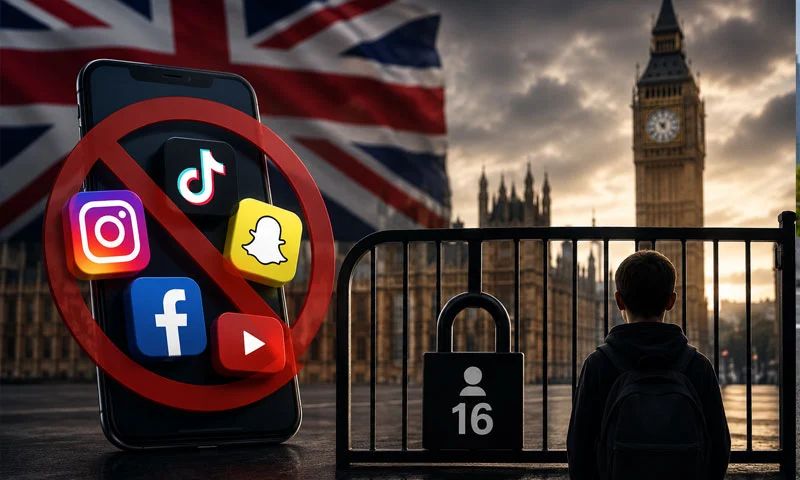
British Prime Minister Keir Starmer has announced a sweeping ban on social media use for children under the age of 16, describing the measure as one of the toughest online safety policies introduced by a democratic country.
Speaking at a press briefing on Monday, Starmer said the government would move ahead with legislation aimed at restricting under-16s from accessing major social media platforms.
“Today I can announce the government will ban access to social media for all children under the age of 16,” Starmer said.
“I am not prepared to compromise on the safety and happiness of our children. That is why this ban must happen and it is why this ban will happen.”
The proposal goes beyond restrictions introduced by Australia last year and forms part of a wider package designed to strengthen child safety online.
Starmer said the government would also introduce what he described as “world-leading action” to stop children from communicating with strangers on gaming services and live-streaming platforms without supervision.
The Labour government plans to pass legislation by the end of 2026 and implement the restrictions in spring 2027.
Authorities will use age verification technology to enforce the rules. However, educational and child-focused services such as YouTube Kids and Google Classroom will remain exempt.
Government Targets Addictive Online Features
Starmer acknowledged the policy would generate debate but argued that growing evidence justified tougher action.
“This is not something I do lightly and I will not present it as cost-free,” he said.
He accused social media companies of designing products that encourage excessive use among young people.
“Social media is designed to be addictive,” Starmer said, criticising “features like infinite scroll” that he argued prevent children from studying, reading, socialising and maintaining healthy sleep habits.
The announcement reflects a growing international debate about the impact of social media on children’s mental health, wellbeing and development.
Several countries have recently explored stronger regulations for technology platforms as concerns rise over online addiction, cyberbullying and harmful content exposure.
When asked whether the move could trigger criticism from US technology firms or President Donald Trump, Starmer rejected suggestions that innovation and online safety were incompatible.
“This is about fighting for what we think is right. I’m a fan of tech and AI,” he said.
Political Debate Intensifies Over Timing
The announcement comes during a politically sensitive period for the British prime minister.
Starmer is attending the Group of Seven summit in France while also facing questions about domestic challenges, including defence spending and cabinet resignations.
Several opponents have already criticised the proposal.
Ian Russell, whose daughter died in 2017 after exposure to harmful online content, told the BBC it would be “deplorable” if the government rushed the policy for political reasons.
The Liberal Democrats also criticised the proposal, accusing Labour of “rushing through a half-baked policy just to secure a political legacy.”
Supporters of the plan argue that stronger safeguards are necessary as children spend increasing amounts of time online.
Lawmakers will continue debating the proposal as they prepare legislation and technology companies assess how age verification systems could operate at scale.
If lawmakers implement the plan, the UK will become one of the most restrictive countries in the democratic world regarding children’s access to social media and could create a model that other governments follow.