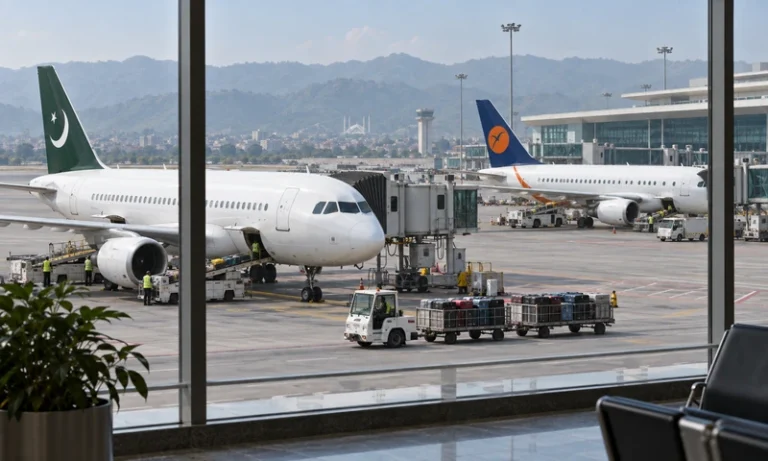
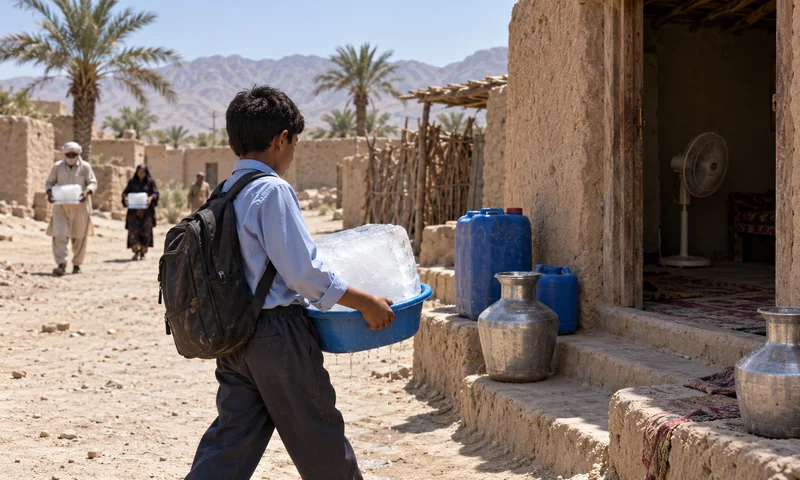
Families in Balochistan are relying on daily ice blocks to survive temperatures approaching 50C as electricity shortages leave refrigerators and fans useless.
Nasirabad lies about 40 kilometres from Turbat in Kech district. Most residents live in poorly ventilated mud houses and receive electricity for roughly three hours daily.
Weak voltage often prevents refrigerators from working. Many families also cannot afford solar panels or batteries.
Children queue for ice before school
Residents carrying buckets, sacks and plastic containers queue outside the town’s only ice factory each morning. Twelve-year-old Taimoor collects ice before school because his pregnant mother fears the journey could threaten her pregnancy after two miscarriages.
“If I do not bring the ice, how will we endure the heat at home?” he said. “And how will we drink water that feels as though it is boiling?”
Taimoor leaves some ice at home and carries a small portion to school.
Read More: Balochistan govt, NBP launch subsidized electric scooter scheme for students, women
The Pakistan Meteorological Department warned in May that Turbat and nearby areas could experience temperatures between 46C and 50C. Its August outlook predicted very hot and dry conditions across Balochistan.
Ice factory becomes town’s cooling centre
Mohammad Haider’s father established Nasirabad’s ice factory in 1992. Workers open it around 7am and usually sell all 400 blocks made overnight within two hours.
Most customers cool drinking water, but shortages send some home empty-handed.
“It saddens me when people cannot get ice before it runs out,” Haider said. “They then have to spend the entire day drinking warm water.”
Haider gives residents free cold water outside the factory in the evening.
Scarcity has created informal reselling. Residents sometimes buy a piece for 40 rupees and later sell it for 80 rupees.
Sixty-six-year-old widow Raj Bibi cannot afford ice or solar equipment. She carries water bottles to a neighbour with a solar-powered refrigerator and collects them in the evening.
“The day passes in heat and suffocation,” she said. “There is no electricity to run a fan, and I cannot afford solar panels.”
Climate risks expose deep inequality
Even households with solar panels remain vulnerable because many cannot afford batteries. Without stored power at night, residents often carry bedding outdoors and sleep beneath the sky.
The World Meteorological Organization says Asia is warming nearly twice as fast as the global average. It confirmed that the 11 years through 2025 ranked as the hottest on record globally.
Pakistan ranked 147th in the 2024 Notre Dame Global Adaptation Initiative index. The ranking reflects high climate vulnerability and limited readiness.
Read More: Pakistan Olive Cultivation Targets $4 Billion Import Bill
Authorities have heatwave plans and advise hydration, reduced sun exposure and livestock protection. However, residents say they see little support.
Farmers must still work in orchards, while women cook over wood fires because Nasirabad lacks gas. Families instead depend on shared refrigerators, limited solar power and one factory producing 400 ice blocks each night.