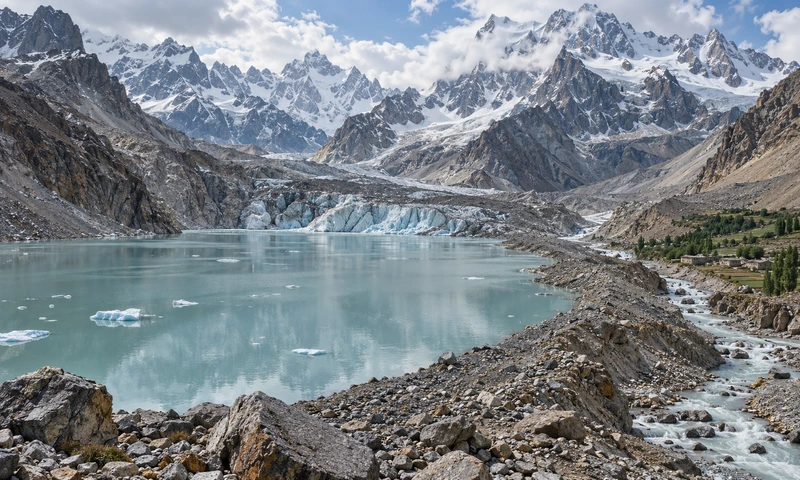
Pakistan’s monitored unfrozen glacial lakes increased from 40 to 105 between July and August, raising concerns about downstream flood risks. Satellite assessments also showed that some lakes had expanded beyond their previously recorded maximum boundaries.
The findings indicate seasonal thawing and expansion, rather than confirming that 65 entirely new lakes formed.
Satellite images reveal expanding lakes
The Space and Upper Atmosphere Research Commission, Suparco, compared imagery over time, using August 5 as its latest observation.
Its August assessment identified 131 potentially dangerous glacial lakes. Provincial disaster management authorities and Wapda’s glacier monitoring and research centre supplied their locations.
Suparco mapped the lakes using optical imagery to estimate surface areas and distinguish frozen from unfrozen water bodies.
“At present, 105 lakes are observed to be unfrozen, compared with 40 lakes reported earlier. The current assessment also indicates temporal variation in extent, where few lakes have exceeded their previous recorded maximum extents,” it said.
Read More: 22 Dead, 384 Missing After Devastating Nepal Flash Floods
The agency had recorded 40 unfrozen lakes on July 2. Most then remained within their historical maximum boundaries.
Persistent cloud cover subsequently restricted access to clear satellite images, complicating precise assessments of changes in lake size.
Expansion beyond historical limits can indicate greater water storage and possible instability in natural dams formed from glacial debris. Dam failure can trigger a glacial lake outburst flood, or Glof.
Suparco urged heightened preparedness, “particularly in downstream valleys of potentially dangerous glacial lakes”. It said satellite monitoring would continue throughout the melting season.
Glaciologist calls for field investigations
Dr Karamat Ali, a glaciologist at Karakoram International University, said satellite observations alone could not adequately establish the hazards.
“Glacial melt is a serious concern. Numerous parameters are ignored which can only be verified from field studies, and mere satellite imagery will not suffice.”
Ali, who has studied glaciers for two decades, criticised fragmented work, weak coordination and distrust among stakeholders.
He identified gaps in knowledge about glacier morphology, local microclimates and seasonal mass accumulation. He also highlighted insufficient information about hanging glaciers, citing destructive losses in Nepal during September.
Ali called for investigations of lake depths, surrounding terrain and end moraines, the debris accumulated at glacier fronts. He questioned government investment in addressing rapid glacier melt.
A glacier inventory completed in 2024 counted more than 13,000 glaciers across Pakistan.
Warming increases downstream risks
Climate ministry spokesperson Mohammad Saleem Shaikh said warming across the Hindu Kush-Karakoram-Himalaya region was transforming Pakistan’s frozen landscapes.
Read More: Rising Winter Heat Could Trigger Glacier Floods in Pakistan
“The science is unequivocally clear that rising temperatures are reshaping Pakistan’s mountain ecosystems at an unprecedented pace. Every fraction of a degree of warming increases the risk to communities living downstream. Our response must therefore be science-driven, technology-enabled and translated into timely action to protect lives, livelihoods and critical infrastructure,” he emphasised.
Pakistan’s Glof risk-reduction efforts also include community preparedness and protective infrastructure. UNDP’s GLOF-II programme incorporates early warning systems, weather monitoring, flood gauges and drainage works to help vulnerable northern communities respond.