
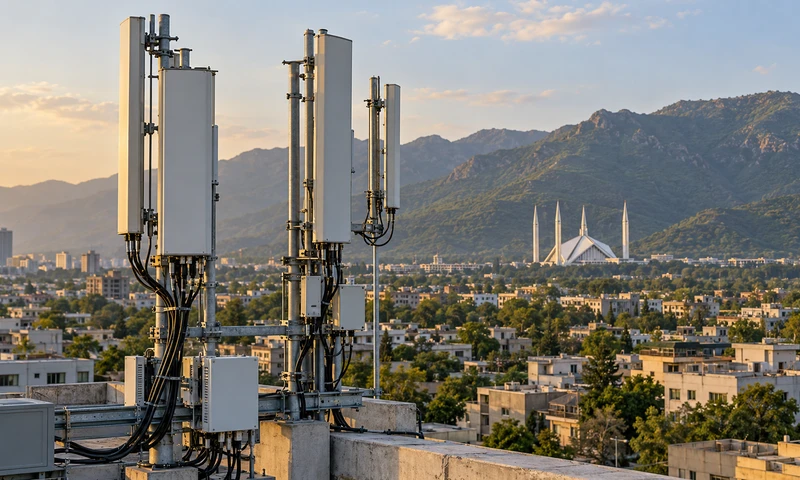
Pakistan has expanded 5G services to 24 major cities following a $509 million spectrum auction, IT Minister Shaza Fatima Khawaja said. Operators activated more than 1,700 sites within six months, delivering average speeds of 130 Mbps.
Speaking in Seoul, South Korea, Khawaja said nationwide download speeds had increased by 68.1% over the preceding two years. She outlined the expansion at the Global Digital & AI Summit, linking better connectivity with Pakistan’s artificial intelligence ambitions.
Her panel carried the title “The Last 2.6 Billion: Is Universal Connectivity a Broken Promise in the AI Era?”
The World Bank Group and South Korean ministries are hosting the October 19–22 summit, focusing on digital development and practical AI applications.
Spectrum auction strengthens Pakistan’s 5G network
Khawaja said Pakistan held its largest-ever spectrum auction in March 2026, adding 480 MHz to operators’ holdings. This increased their combined spectrum from 274 MHz to 754 MHz, drawing recognition from GSMA and the Asia-Pacific Telecommunity.
Under the prime minister’s Digital Nation Pakistan vision, the government views AI primarily as a network challenge, she said. Reliable, accessible connectivity would underpin that transformation.
Around 70% of Pakistan’s population is under 30, while telecom subscriptions have exceeded 200 million, she added.
Fibre expansion and satellite connectivity
Pakistan has deployed more than 234,000 kilometres of optical fibre nationwide. The government has abolished right-of-way charges to lower deployment costs and accelerate expansion.
Six submarine cables connect Pakistan internationally, providing combined capacity exceeding 17 terabits per second. Meanwhile, work continues on the CAREC Digital Corridor to connect Central Asia with global networks.
Read More: Easypaisa App to Reach New Infinix, TECNO and itel Smartphones
Khawaja identified direct-to-device satellite connectivity as an option for underserved communities in Balochistan’s deserts and northern Pakistan’s mountainous areas.
The Pakistan Space Activities Regulatory Board and Pakistan Telecommunication Authority are finalising the satellite communications and licensing framework. Satellite services would complement terrestrial networks, particularly where conventional infrastructure remains difficult to deploy.
Pakistan has also introduced a mobile virtual network operator framework and an Infrastructure Sharing Policy. Both seek to attract investment and improve infrastructure use.
Smartphone affordability and digital inclusion
The Universal Service Fund has connected more than 38 million people across 22,100 settlements in over 110 districts, Khawaja said.
Local manufacturers assembled 17.6 million smartphones in 2025. The government is also introducing smartphone instalment plans to improve device affordability.
Read More: Pakistan Gets New Chipless CNIC With Smartphone Verification
Citing World Bank reports, she said Pakistan’s mobile connectivity gender gap had narrowed from 25% to 8%. Pakistan also climbed 27 places in the International Telecommunication Union’s ICT Development Index 2026, she added.
Khawaja described universal connectivity as an unfinished commitment rather than a broken promise. She urged stronger cooperation and shared investment risks to reach underserved populations.
The necessary technology and financing already existed, she said. Connecting the world’s 2.6 billion unconnected people could open opportunities for customers, creators and innovators, with Pakistan ready to join such partnerships.