

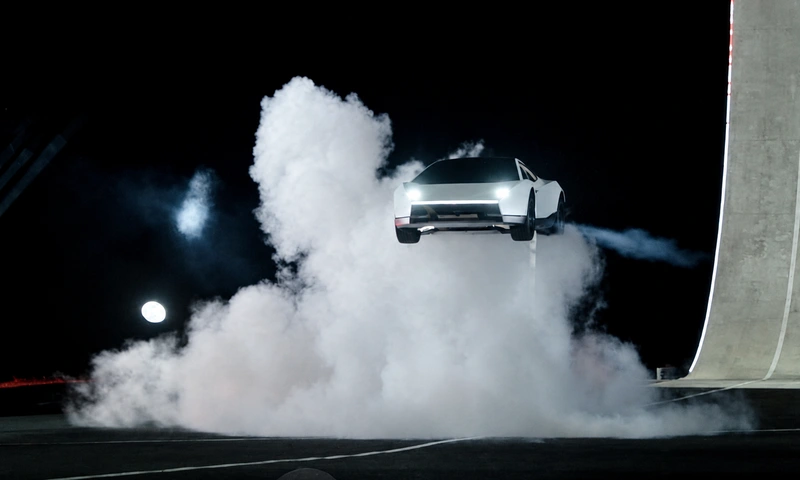
Tesla unveiled its redesigned Roadster on Thursday, October 15, showing the electric supercar briefly take flight during a demonstration in Texas.
The vehicle drove upside-down on a huge curved ramp, flipped into the air and hovered briefly before landing safely. Tesla staged the event at SpaceX’s rocket development and testing facility in McGregor, near Waco.
“Well, it worked,” Tesla chief executive Elon Musk said after the landing.
“Flying cars are real,” added Lars Moravy, Tesla’s vice president of vehicle engineering.
In another demonstration, the Roadster flipped over a line of Tesla vehicles, floating above the Cybertruck before returning to the ground.
The display revived attention around a project Tesla first announced in 2017. The company originally promised deliveries in 2020, but repeated delays have kept customers waiting.
How the Tesla Roadster takes flight
Moravy said SpaceX thrusters enable the car’s airborne manoeuvres. According to his explanation, the Roadster uses 10 thrusters connected to 600 litres of compressed air.
The system allows the vehicle to lift and rotate in midair. Tesla also used a suction system to keep the car attached to the ramp during its upside-down run.
“More compressed gas on board = more flight time,” Tesla explained in an X post.
Read More: Nine Years After Its First Reveal, Tesla Roadster Returns on October 1
The demonstration showed short airborne movements and controlled landings. It did not establish the vehicle as a substitute for conventional aircraft or demonstrate sustained flight over long distances.
Tesla’s website also limits its flight-related feature claim to the Rocket trim, which it says will not reach every region. The page identifies other advertised specifications as applying to the optional Thrust upgrade.
Acceleration claims accompany aerial display
Tesla said the Roadster could accelerate from zero to 60mph, approximately 97km/h, in about one second. Reporting from the event put the company’s claim at under one second.
Moravy also cited a top speed exceeding 230mph, or roughly 370km/h. These remain company performance claims rather than independently verified production-car results.
Turns out the future does have flying cars https://t.co/6fexPp6SXI
— Elon Musk (@elonmusk) October 16, 2026
The combination of rapid acceleration and airborne stunts made the reveal a showcase for Tesla’s collaboration with SpaceX.
However, the distinction between demonstration hardware and the eventual customer specification remains important. Tesla’s own website separates the Thrust and Rocket configurations instead of promising identical capabilities across the range.
When will the Roadster go on sale?
Musk now targets production in 2028, extending the wait well beyond Tesla’s original delivery promise. The company did not announce final vehicle prices at the unveiling.
That timetable represents a production target, rather than confirmation that customers will receive vehicles on a specific date.
Read More: Tesla Hits 10 Million EVs as Global Auto Race Intensifies
The new model follows Tesla’s original Roadster, the vehicle that launched the company’s electric sports-car business.
For prospective buyers, the Texas event answered whether Tesla could demonstrate a briefly airborne Roadster. Final pricing, delivery schedules and the availability of each configuration remain central questions before the car reaches customers.